$1 today for 24 hours·Then from $27/mo unless you cancel·Reminder email ~6h before it ends
Script → storyboard → animatic
AI image + video in one timeline
Voice, music & SFX built in
Client-ready MP4 exports
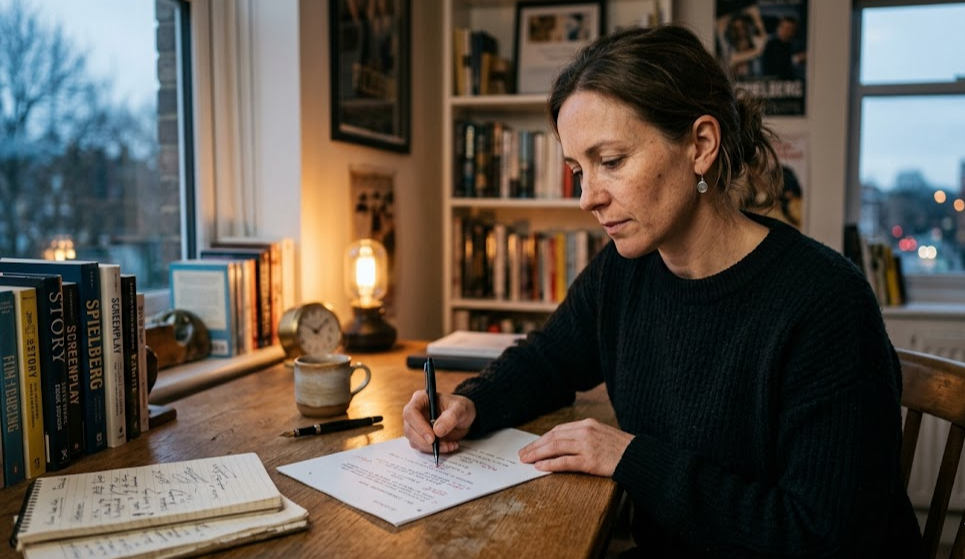
A screenplay is written in a specific format: scene headings in caps, action in present tense, character cues centered, dialogue indented. One page of correctly formatted screenplay equals roughly one minute of screen time. You write one by breaking your story into scenes, writing action that shows (not tells), and keeping dialogue specific to each character's voice.
Proper screenplay format: sluglines in caps, action in present tense, character cues centered, dialogue indented.
This guide covers how to write a screenplay from the first blank page through final draft — format, structure, scene-level craft, and the mistakes that get first-time writers rejected by every reader they send it to. At the end we cover AI-assisted screenwriting workflows.
The two-page rule before you start
Before you write a line, read two produced screenplays in your genre. Not books about screenwriting — actual shooting scripts. They're free: IMSDB, Simply Scripts, the Writers Guild library, or the screenplay PDFs most studios post during award season.
Reading scripts tells you more about format, pacing, and dialogue than any book will. After two, you understand the rhythm. After five, you can feel what a page-per-minute actually looks like.
Step 1: Lock your premise
A premise is one sentence. Protagonist + goal + obstacle + genre.
"A retired hitman hunts down the gangsters who killed his dog." (John Wick)
"A young woman realizes her small-town life is a scripted simulation." (The Truman Show)
"Two detectives investigate a series of murders based on the seven deadly sins." (Se7en)
If you can't write your premise in one sentence, you don't have a premise yet. You have a mood. Keep working until the sentence exists and the obstacle is concrete.
Step 2: Write the beat sheet
A beat sheet is 10–40 bullet points covering the major plot turns. Don't write scenes yet. Write the spine.
Act 2A (pages 25–55): Fun and games, rising stakes, B-story introduction, midpoint (page 50–55) — a twist that flips the protagonist's approach.
Act 2B (pages 55–85): Everything falling apart, dark night of the soul (page 75), second act break (page 85) — the lowest point.
Act 3 (pages 85–110): Protagonist's new plan, final confrontation, resolution, final image.
Your beat sheet doesn't have to follow three-act exactly. Non-linear, ensemble, and experimental structures work. But you need SOME spine or you'll drift.
Step 3: Write scene by scene, not chapter by chapter
Screenplays are scenes stacked in order. Each scene has:
A location (INT. COFFEE SHOP - DAY)
A character who wants something in this scene
An obstacle to getting it
A turn — the scene ends differently than it began
If a scene doesn't have all four, cut it or merge it with a neighbor.
Step 4: Write the scene using screenplay format
Slugline — the scene heading. ALL CAPS. INT. or EXT., location, time of day.
INT. COFFEE SHOP - DAY
Action lines — visual description, present tense, no camera direction.
The coffee shop is quiet. ANNA (30s, tired, a stain on her sleeve she hasn't noticed) nurses a cold latte. The door opens. RAY (40s, leather jacket, seen better decades) walks in. He sees her. Stops.
Character names get a brief description the FIRST time they appear. Never again. "(30s, tired, stain on her sleeve)" tells us who Anna is and plants a detail (the stain) we can pay off later.
Dialogue — character name centered, parentheticals only when tone changes meaning.
RAY Coffee that bad? ANNA (not looking up) You're late.
Transitions — CUT TO, DISSOLVE TO, FADE OUT. Use almost never. Editors and directors decide transitions; you decide where scenes end.
Step 5: Make every scene earn its page
If a scene doesn't do at least ONE of these, cut it:
Advances the plot
Reveals character
Plants a setup you'll pay off later
Pays off a setup from earlier
Shifts the protagonist's goal or strategy
Scenes that "set the mood" or "show the world" without doing plot or character work are the number-one reason readers quit at page 30.
Step 6: Write dialogue that actually sounds different per character
Weak dialogue: every character sounds like the writer. Strong dialogue: you could cover the character cues and still know who's speaking.
Techniques:
Give each character a different vocabulary. One says "acquired"; another says "got."
Different rhythms. Short sentences for action; long for thought.
Different filler words. Some characters say "look," others say "listen," others interrupt.
Their goals in the scene differ, so their tactics differ.
The test: open any scene, cover the cues, read it out loud. Can you tell who's talking?
Step 7: Show. Don't tell.
Every first-time screenwriter writes:
Anna is frustrated and tired of her life.
That's a novel sentence. In a screenplay it should be:
Anna stares at the latte. The foam is cold. She hasn't moved in five minutes.
The camera can show the foam. It can't show "frustrated." If you can't show it, it's not screenwriting.
Step 8: Finish the first draft before you rewrite
The single hardest thing about writing a screenplay is finishing the first draft.
Most new writers edit the opening pages 50 times while the rest of the script doesn't exist. Don't do this. Finish, THEN rewrite.
Rule: don't go back to edit until you've typed FADE OUT.
Step 9: Rewrite ruthlessly
The first draft is for you. The second draft is for the reader.
Common things that get cut in revision:
Scenes that don't advance plot (25–30% of most first drafts)
Dialogue that repeats information we already have
Parentheticals telling actors how to read lines
Camera directions embedded in action
Every time you wrote "suddenly"
Good rewrite rule: cut 10–15% of the page count in the second draft. Cut 5–10% more in the third.
Step 10: Format and submit
Final checks before anyone reads:
90–120 pages for a feature. Under that reads as TV. Over, nobody reads it.
Courier or Courier Prime, 12pt. No substitutions.
1.5-inch left margin, 1-inch right/top/bottom.
Title page: title centered, "by YOUR NAME" below, contact info bottom-left.
Writing a novel, not a screenplay. Internal monologue, long descriptions, character thoughts. None of this works. Screenwriting is a visual medium.
Camera directions. "CLOSE ON Anna's face." "CUT TO the window." The director shot-lists. The writer describes the scene.
Characters tell the reader what's happening. "I'm so angry right now because my father didn't love me." Real people don't say this out loud. Subtext exists.
Too many scenes. A 120-page script typically has 40–80 scenes. If you have 150, many are doing the same work.
Too many characters. Most features have 8–15 speaking characters. Names get confusing past that. Cut or merge.
Starting with a prologue or dream sequence. Readers stop reading.
Once the screenplay is locked, modern AI workflows convert each scene into storyboard frames in minutes.
How AI-assisted screenwriting fits in 2026
AI script generation tools don't replace the writer. They handle bottleneck tasks:
Overcoming the blank page. Give the AI a logline + genre, get back a structured first-draft outline with scenes already blocked out. You rewrite from there.
Breaking scenes into shots for storyboarding. Once scenes exist, AI tools convert them to visual frames automatically. mStudio's script-to-storyboard workflow does this.
Extending an existing draft. Stuck on Act 2? Paste what you have, the AI generates plausible next-scene options. Pick one, rewrite it.
Formatting. AI outputs pre-formatted screenplays (sluglines, action, dialogue) so you spend zero time wrestling with tab stops and Courier.
What AI can't do yet: find the specific human truth that makes a screenplay feel alive. That's still you.
FAQs
How long should a screenplay be? Feature films: 90–120 pages. Comedies trend shorter (90–100), dramas trend longer (110–120). Short films: 1–15 pages. TV half-hour: 22–32. TV hour-long: 50–65.
What software do professional screenwriters use? Final Draft is the industry standard. Celtx, WriterDuet, and Fade In are cheaper alternatives. Google Docs with a screenplay template works for spec scripts. Professional staffed TV rooms usually require Final Draft.
How long does it take to write a screenplay? First draft: 8 weeks to 6 months typical. Rewrite cycle: 2–4 more months. From blank page to "ready to send out": 6 months to 2 years for most new writers.
Should I outline before writing? Most working writers outline. Some don't. Try both on short projects first. A feature without any outline has ~70% chance of stalling mid-script; outlined features stall ~20%.
Can I use AI to write my screenplay? You can use AI for outlining, breaking scenes, overcoming writer's block, or generating alternate takes. Treat the AI output as first draft you rewrite. Don't submit AI output unedited — readers can tell.
What makes a bad screenplay bad? Usually one of: no clear protagonist goal, too many characters, scenes that repeat information, dialogue that sounds the same from every character, no act-level structure, novel-style prose in action lines, overwritten parentheticals.
How do I sell a screenplay? The hardest part and out of scope for this guide. Briefly: finish it, get 3-5 readers you trust to give notes, rewrite, query managers or enter competitions (Nicholl, Austin Film Festival, BlueCat), or post in script-exchange communities. Professional representation moves the odds from unsaleable to 100-to-1 instead of 10,000-to-1.