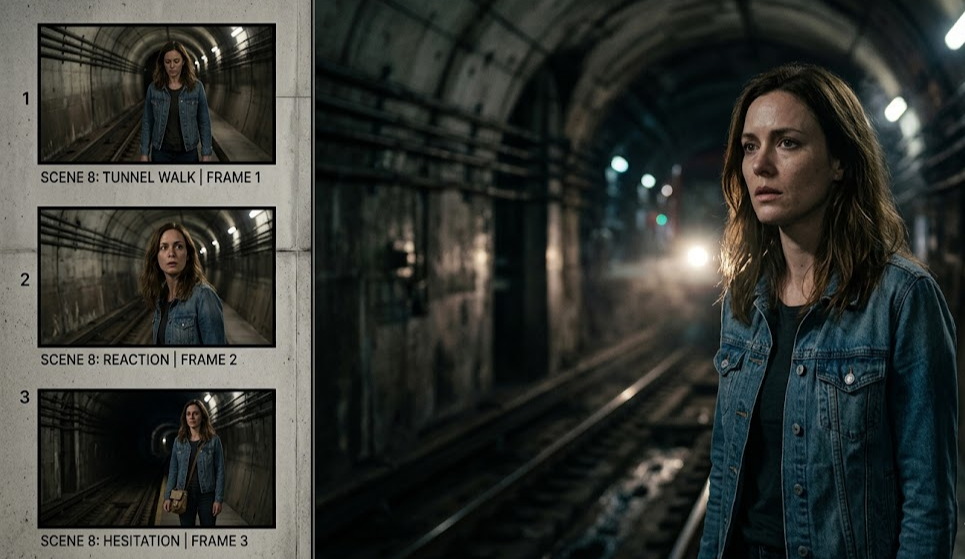
Script to Storyboard AI: What Happens After the Frames?
If you've searched for "script to storyboard AI," you've probably landed on Drawstory.ai. It does one thing well: upload your script, get storyboard frames back without prompting. Clean workflow, good consistency across shots.
But here's the problem every filmmaker hits within a week of using it: the storyboards are done, and you're still not making a film. You have JPEGs. You have a folder of pre-production assets. You have nothing that moves.
This post covers the full workflow — from script to storyboard to actual video — and where tools like mstudio.ai fit once storyboarding is done.
How Script-to-Storyboard AI Actually Works
Tools like Drawstory.ai parse your script and use AI to generate static storyboard panels — one frame per scene or shot. The pitch is speed: what used to take a storyboard artist days takes minutes. Character consistency is handled automatically, which is the hard part.
Here's what that workflow produces:
- A visual shot plan for the director
- Client-presentable pre-viz for pitches
- Reference images for your team
- A sequence of static frames in rough narrative order
What it doesn't produce: motion, audio, transitions, or anything you can actually cut in your NLE.
The Gap Between Storyboard and Screen
After storyboarding, the real production work begins. Most AI storyboard tools — including Drawstory.ai, Boords, and Storyboarder.ai — are built for pre-production. They're done when the frames are done.
The production gap looks like this:
- Script parsing → storyboard frames (Drawstory handles this)
- Frames → animatics with timing
- Animatics → AI video generation per shot
- Video clips → assembled cut with transitions, audio
- Cut → final export to distribution format
At step 2, Drawstory stops. You're paying a subscription fee for the first step of a 5-step pipeline, then sourcing and paying for each tool that covers steps 2 through 5.
What mstudio.ai Does Differently
mstudio.ai is built to run the full pipeline, not just the first leg. Think of it as the production layer that sits above AI video generators — the AI filmmaker's equivalent of After Effects, but built from the ground up for AI-generated footage rather than grafted onto a traditional NLE workflow.
The workflow in mstudio.ai:
- Import your storyboard frames (or generate them in the tool)
- Generate video clips per shot using the AI video model of your choice (Kling, Runway, Veo)
- Assemble clips on a timeline with transitions
- Add BGM, SFX, and voiceover directly in the editor
- Export a finished video — full-length film, short, or reel — without touching a separate NLE
The key difference from Drawstory: you're not handing off to another tool at step 2. The editing environment IS mstudio.ai. You're not downloading MP4s, re-importing them, manually stitching clips in After Effects, then adding audio separately. That workflow is what mstudio replaces.
Comparison: Drawstory.ai vs mstudio.ai
Both tools start at the same place — your script. They diverge fast after that.
- Script parsing: Both parse scripts and generate scene breakdowns
- Storyboard frames: Both generate consistent character frames without per-shot prompting
- Animatics: Drawstory stops here (static export only) | mstudio.ai generates timed animatics
- Video generation: Drawstory: none | mstudio.ai: integrated AI video per shot
- Timeline assembly: Drawstory: none | mstudio.ai: timeline editor with transitions
- Audio: Drawstory: none | mstudio.ai: BGM, SFX, voiceover in-editor
- Export: Drawstory: static image frames | mstudio.ai: finished video file, full-length capable
- Pricing: Drawstory: subscription (see drawstory.ai/pricing) | mstudio.ai: see mstudio.ai/pricing
When Drawstory.ai Makes Sense
Be precise about where Drawstory wins. If your job ends at pre-production — you're a storyboard artist, a pitch consultant, or you hand off to a live-action crew — Drawstory is a solid tool. The character consistency is genuinely good, and the no-prompt interface makes it fast to use with clients who need to approve shots before anything is shot or generated.
If your goal is an actual film, short, or video — something that plays — Drawstory is a dependency, not a destination.
The Full AI Film Production Workflow (With Tools)
Here's how a complete 2026 indie film workflow looks with the right tools:
Script (.fountain or .pdf)
  ↓
Scene breakdown + character extraction
  ↓
Storyboard frame generation (consistent characters)
  ↓
Animatic with shot timing
  ↓
AI video generation per shot (Kling, Runway, Veo)
  ↓
Timeline assembly — cuts, transitions, audio
  ↓
Final export (full-length video file)
  ↓
Color grading, distribution
mstudio.ai covers steps 2-8. You bring the script and handle the final creative decisions. Everything in between — character consistency, animatics, video generation, cut, audio — happens in one environment without re-uploading assets between tools or touching a separate NLE.
Common Questions
Can I use my Drawstory storyboards in mstudio.ai?
Yes. If you've already generated storyboard frames in Drawstory, you can import them into mstudio.ai as reference images for your shots. mstudio.ai will use them as the visual base when generating video clips, so your pre-production work doesn't go to waste.
Does mstudio.ai require prompting for each shot?
No. Like Drawstory, mstudio.ai extracts character and scene data from your script. You're not prompting Midjourney for each panel — the system maintains character consistency automatically across shots.
What AI video models does mstudio.ai use?
mstudio.ai integrates with the leading generation models including Kling, Runway, and Veo. You can select per shot based on what each scene needs — slower, more cinematic motion for dramatic beats, faster generation for action cuts.
What does the export from mstudio.ai look like?
mstudio.ai exports your finished film as a video file ready for distribution or delivery. Since mstudio.ai is your editing environment — not a pre-production tool that feeds another NLE — you're not importing into After Effects at the end. You're finishing the film in mstudio.ai itself: cuts, transitions, audio, export.
Get Started With Script-to-Film in mstudio.ai
If you're at the storyboarding stage and want to know what your script actually looks like as a moving film before committing to live-action production costs, mstudio.ai is where to start.